


Vietnam’s industrial real estate market maintained positive momentum in the first quarter of 2026, supported by high occupancy, rising rents, expanding supply and continued demand from manufacturing and logistics businesses. Industrial land rents ranged from $90 to $250 per sq m per lease term in northern Vietnam, compared with $70–$120 in the central region and $185 to over $280 in southern Vietnam, where occupancy exceeded 90%. Against this backdrop, the market for Vietnam industrial land for sale is entering a new phase in which infrastructure, connectivity and the quality of industrial locations are becoming increasingly important to investment decisions.
Vietnam Industrial Land for Sale Supported by High Occupancy and Rising Rents
Industrial property indicators remained strong during the opening quarter of 2026. Occupancy for industrial land exceeded 80% in northern Vietnam and 90% in the south, while rents for ready-built factories and warehouses nationwide increased 3–6% year-on-year, according to DTJ Industrial. The combination of high occupancy and rising rents demonstrates continued demand for industrial assets despite uncertainties in the broader global environment. It also indicates that established industrial locations remain important as manufacturers assess opportunities for production expansion.
Northern Vietnam alone has nearly 13,000 ha of industrial land across more than 70 operational industrial parks. More than 100 ha of new supply entered the market during the first quarter, while occupancy reached 82%. The cumulative leased area increased to 10,400 ha, representing growth of 5% year-on-year. With nearly half of developed industrial land concentrated among major market players, these figures point to an increasingly established and competitive market, where scale, infrastructure readiness and the ability to meet evolving investor requirements are becoming more important.
Ready-built industrial properties are expanding alongside industrial land. Ready-built factory supply in the north surpassed 3.6 million sq m across 91 projects, up 14% from a year earlier, with another 159,000 sq m added during the first quarter. Occupancy reached 87%, while rents ranged from $4 to $7.1 per sq m per month, up 4% year-on-year. Leasing activity was particularly concentrated in Bac Ninh and Hai Phong, reinforcing the position of established manufacturing centers within northern Vietnam’s industrial landscape.
Manufacturing, Logistics and FDI Are Reshaping Industrial Demand
Modern ready-built warehouse supply in northern Vietnam reached 2.2 million sq m, equivalent to a 1.7-fold year-on-year increase, while another 162,000 sq m was added during the first quarter. Average rents rose 10% year-on-year to $5.1 per sq m per month, the strongest rental increase among the three industrial property segments. The expansion of warehouse supply reflects the growing role of logistics alongside manufacturing as Vietnam’s industrial property market develops.
Among this new supply was Jeil Logistics Hai Phong, developed by South Korea’s Jeil Group at Nam Dinh Vu Industrial Park in Hai Phong. Jeil Group’s selection of Nam Dinh Vu for its logistics project reflects the growing importance of industrial locations capable of supporting both manufacturing and logistics activities within northern Vietnam’s major supply chains. As investors place greater emphasis on infrastructure readiness and connectivity, such investment decisions also illustrate how established industrial locations are being positioned within the next stage of market growth.
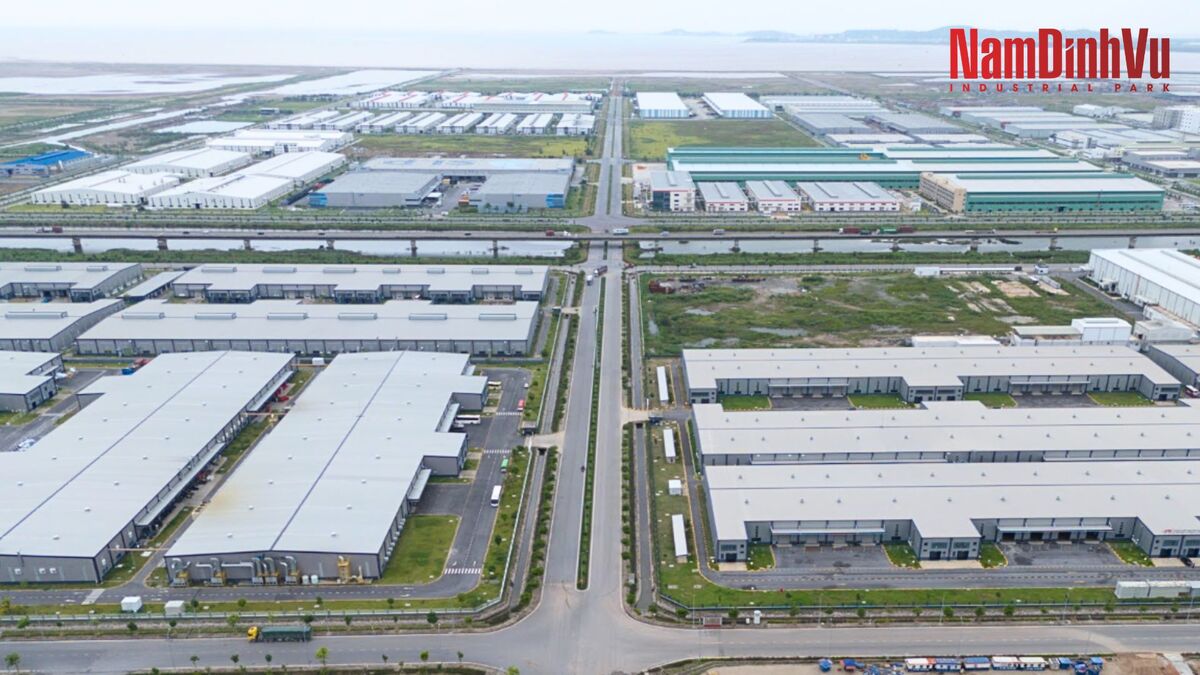
Demand is coming from manufacturers, retailers and e-commerce companies serving both domestic and export markets, but occupiers are becoming increasingly selective. Facilities with strong connectivity, completed infrastructure and high operating standards are being prioritized as companies seek to control costs and improve supply chain efficiency. Global supply chain diversification is reinforcing this demand, with investors from South Korea, Singapore, China, Japan and Europe continuing to expand in electronics, semiconductors, automotive components and other high-tech industries. Newly-registered FDI also surged during the first quarter of 2026, with manufacturing and processing continuing to attract capital.
Infrastructure Creates the Next Growth Phase for Industrial Real Estate
Infrastructure investment is becoming an increasingly important driver of Vietnam’s industrial property market. Approximately 234 large-scale projects are underway with an estimated total investment of VND3,400 trillion ($130.8 billion). Major developments include Long Thanh International Airport, metro systems in Hanoi and Ho Chi Minh City, and more than 380 km of newly-operational North-South expressways, helping open new economic corridors and strengthen connections between manufacturing centers, logistics networks and major urban markets.
Additional projects such as Ring Roads 4 and 5 in the Hanoi region, Gia Binh Airport and the Hanoi–Ha Long high-speed railway are expected to strengthen supply chains across the Red River Delta. Vietnam is also developing new economic and trade zone models. The planned Hung Yen Free Economic Zone covers 30,538 ha with a total investment of $18 billion, while Hai Phong’s free trade zone has entered implementation with a focus on integrating port, logistics and industrial ecosystems. These developments are strengthening the relationship between transport infrastructure, industrial property and increasingly sophisticated supply chains.
The scale of the southern market further demonstrates the sector’s long-term expansion. The Southern Key Economic Region, comprising Ho Chi Minh City, Tay Ninh and Dong Nai, currently has 36,400 ha of industrial land across 161 projects, together with 6.6 million sq m of ready-built factories and 6.65 million sq m of warehouses. Over the past decade, industrial land supply has increased by more than 80%, while prices have risen by more than 120%. By 2036, southern industrial land supply is expected to reach at least 58,557 ha, accompanied by 7.76 million sq m of ready-built factories and 7.31 million sq m of warehouses, demonstrating the substantial scale of the market’s longer-term development pipeline.
In conclusion, Vietnam’s industrial real estate market is moving from rapid expansion toward a development model increasingly defined by infrastructure quality, operational efficiency and strategic connectivity. JLL expects northern industrial rents to increase by 4–6% annually, particularly around seaports, airports and major expressways, while industrial land occupancy is projected to remain above 80%. With expanding FDI, new infrastructure corridors, growing ready-built supply and international investors such as Jeil Group selecting established locations including Nam Dinh Vu Industrial Park, the market for Vietnam industrial land for sale continues to evolve toward locations capable of supporting efficient, connected and resilient long-term industrial operations.
Source: VnEconomy